The Phone Storage Plan
For an Android phone that is filling up: sizes read in the right units, the date your space runs out, the space you can free for good, an archive that keeps two copies, and the storage tier your next phone actually needs
AndroidMix's File Size Converter turns one size into another. It does not tell you when your phone will be full, what you can free without losing anything, or how much storage your next phone needs. Writing this pack we fixed the converter itself: it counted every KB, MB and GB as powers of 1024 and said that was how Android reports sizes, but Android's own documentation says that since Android 8 "kB = 1000 bytes, MB = 1,000,000 bytes". A size read off a phone converted 7.37% too big at GB. It now offers decimal GB and binary GiB by their proper names. The Phone Storage Plan turns Settings > Storage into a date. In its worked example a 128 GB phone (119.21 GiB on a Windows PC) is 86.72% full, grows 8.39 GB a month measured from one photo and one video clip, and has 4.20 GB above a 10% floor: 15 days. Space that stays free (10.60 GB; the 3.10 GB of caches comes back and is left out) makes it 1 month; archiving 13.70 GB of older video with two copies makes it 3; a monthly archive habit makes it 8. For the next phone, kept 3 years, 512 GB is the smallest tier that lasts without the habit and 256 GB with it. Every figure is computed by the site's File Size Converter and the formula on each page; the phone, its growth and the prices are examples, not anyone's phone or any shop's prices. It promises no recovery of anything, keeps Clear storage (which, in Android Help's words, "Permanently deletes all app data") apart from Clear cache, never asks you to root a phone, and names no phone, card, drive or cloud service. Included: 24 printable pages with seven steps, four working pages, two reference tables and a quickstart, plus a personalised sheet worked on the size you convert.
Look inside
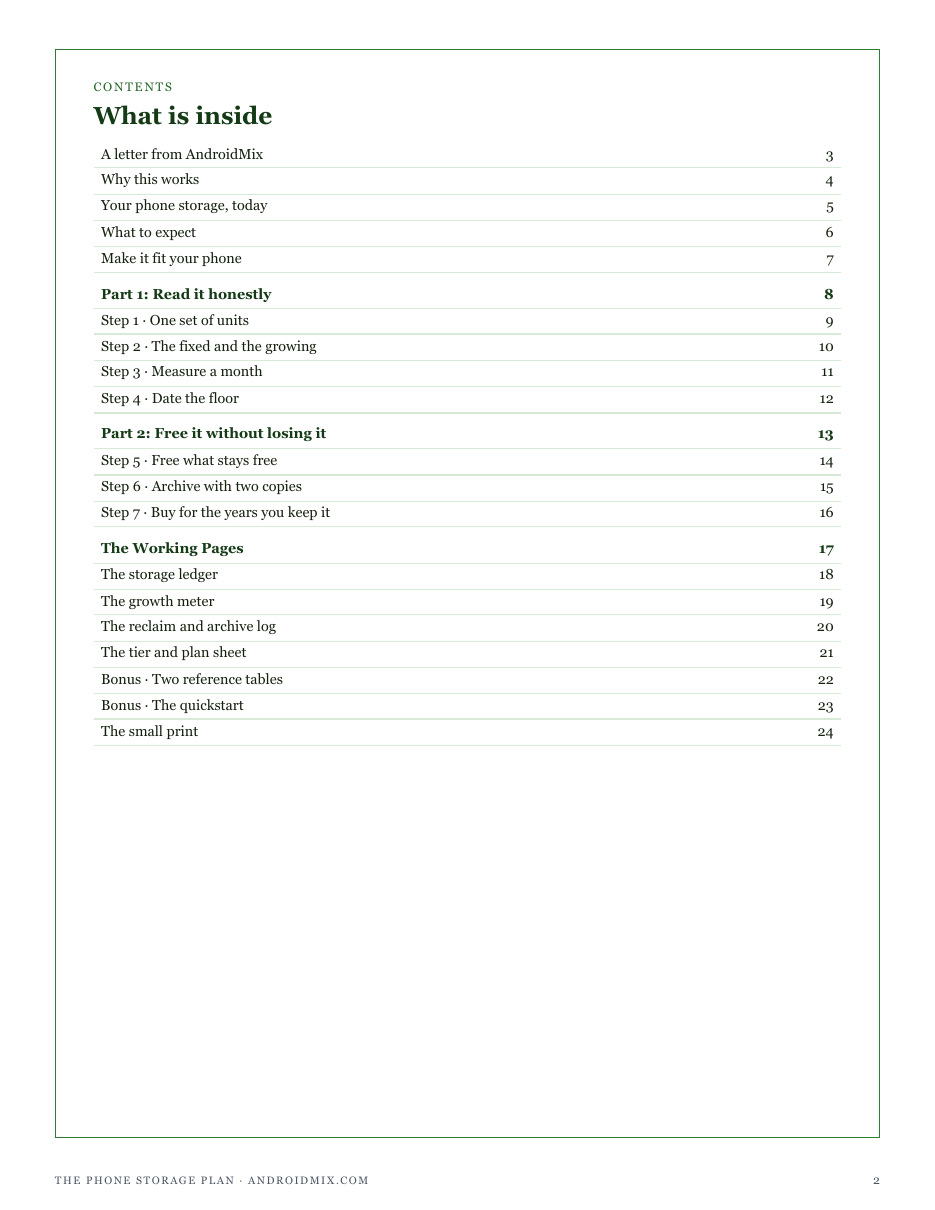
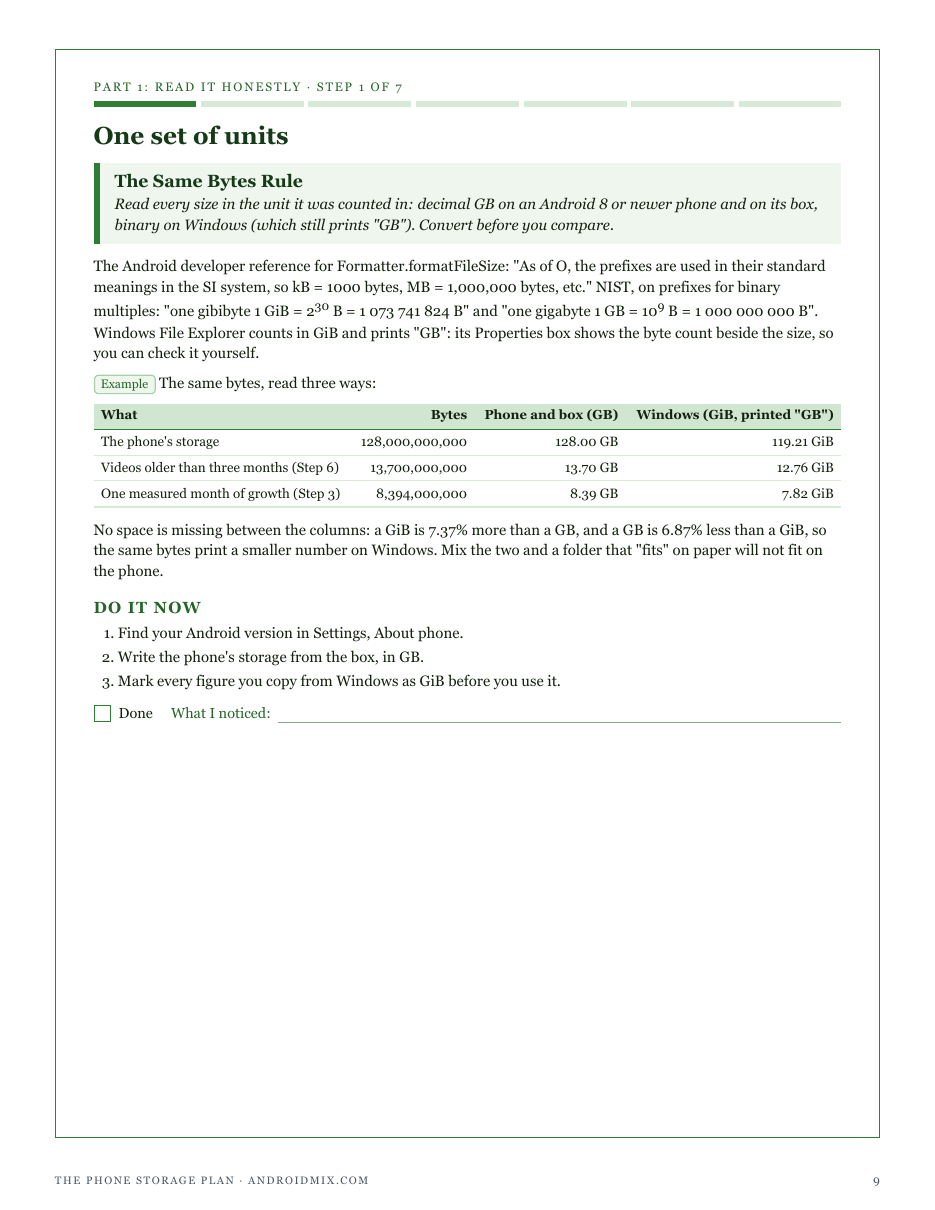
Two full pages from the plan, exactly as printed. Click either to read it at full size before you decide.
What is in it
- Step 1: one set of units: decimal GB on an Android 8 or newer phone and its box, binary GiB on Windows, converted before you compare
- Step 2: Settings > Storage split into the fixed part (system, apps) and the growing part (photos, video, audio, documents)
- Step 3: a month of growth measured from your own photo and video clip, checked by a second reading 30 days later
- Step 4: a 10% floor (a rule of thumb) and the date your free space reaches it, in whole months and days
- Step 5: space that stays free, counted apart from caches that come back; Clear cache kept apart from Clear storage
- Step 6: an archive with two copies, one opened, before anything leaves the phone, and a monthly habit that stops video piling up
- Step 7: the next phone's storage tier picked by the years you keep it, with and without the habit, at your own prices
- Four working pages: a storage ledger, a growth meter, a reclaim and archive log, and a tier and plan sheet
- Two reference tables (what each storage size reads as; whole months a room lasts) and a quickstart that closes the score loop
- A personalised sheet: your size in bytes, as your phone shows it and as Windows shows it, the floor for a phone of that size, and how long that much room lasts at monthly growth rates
- ✓ 24 printable pages
- ✓ 10 sections, worksheets and templates
- ✓ A second PDF worked out from the numbers you enter
- ✓ No account needed, just an email address
- ✓ Instant download; link valid 7 days
Price includes any taxes. Sold by GrabURL, who handle checkout and support. The charge appears on your statement as GrabURL.
The plan picks up where the free File Size Converterleaves off. The converter turns one size into another, in decimal GB as Android 8 and later count or in binary GiB as Windows counts. It does not tell you when your phone will be full, what you can free without losing anything, or which storage tier your next phone needs. The plan does: your Settings > Storage lines read in the right units and split into the part that stays put and the part that grows, a month of growth measured from your own photos and video, the date your free space reaches a floor, the space that stays free after you clear it (caches come back), an archive that keeps two copies before anything leaves the phone, and the next phone’s tier priced by the years you keep it. It promises no recovery of anything, names no phone or cloud service, and every figure in it is an example for you to replace with your own.